
Cost of a dental implant in Belgium: what matters and what is reimbursed
"How much does an implant cost?" is the first question almost every patient asks. The honest answer is that a fixed price does not mean much until the bone has been examined. This article explains what the price is made up of, what makes it vary, and what social security and health insurance funds reimburse in Belgium.
What makes up the price of an implant?
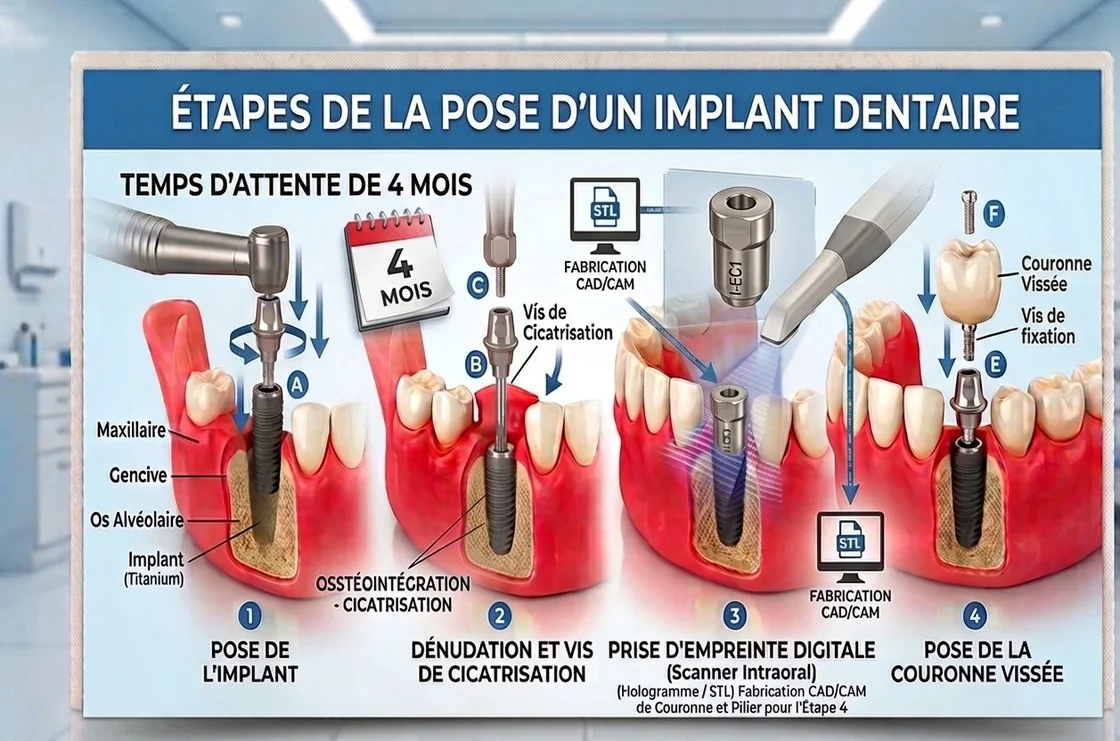
Replacing a tooth with an implant is not a single procedure, but several:
| Item | What it is |
|---|---|
| Assessment | Consultation, 3D scan (CBCT), digital impression, planning |
| Implant | The artificial root in titanium or zirconia, placed in the bone |
| Uncovering | Only if the implant was buried: uncovering the implant and fitting a healing screw |
| Abutment and crown | The abutment, the permanent part screwed onto the implant, and the visible tooth, custom-made by the laboratory |
| Bone reconstruction | Only if bone is missing: bone substitute, bone graft, sinus lift, socket filling |
When you compare two quotes, check what they include. An "implant" price that does not include the crown cannot be compared with a "complete tooth" price.
What makes the price vary
- The amount of bone. This is the main factor. If there is enough bone, the implant is placed directly. If not, a bone graft or a sinus lift is added to the treatment.
- The number of teeth to replace. A single tooth, a bridge on two implants or a full fixed arch on several implants are very different treatments.
- The area. At the front, the aesthetic demands are higher (gum, temporary tooth). At the back of the upper jaw, the sinus is often close.
- The technique. Guided surgery with a 3D-printed guide or dynamic navigation for demanding cases, sedation if needed.
- The crown. Material and laboratory, screw-retained or cemented.
Fees at Face Clinic
When there is enough bone, the price of a tooth on an implant breaks down as follows:
| Stage | Fee |
|---|---|
| 3D scan (CBCT) for the assessment | €180 |
| One-stage placement: implant and healing screw, any area | €1,100 |
| Two-stage placement: buried implant, any area | €1,000 |
| Then uncovering and healing screw | €200 |
| Abutment and final crown, back tooth* | €1,000 |
| Abutment and final crown, aesthetic zone (canine to canine)* | €1,200 |
* Only for patients without a dentist or not referred by a dentist.
The surgical fees depend on the number of stages:
- one-stage placement: the healing screw is fitted at the same time as the implant, €1,100;
- two-stage placement: the implant is first buried under the gum (€1,000), then uncovered a few months later and fitted with a healing screw (€200), making €1,200.
For example, for a molar placed in two stages: 1,000 + 200 + 1,000 = €2,200. For an incisor placed in two stages: 1,000 + 200 + 1,200 = €2,400. In one stage: 1,100 + 1,000 = €2,100 for a molar, 1,100 + 1,200 = €2,300 for an incisor. The 3D scan for the assessment (€180) is added to these amounts.
The CBCT costs €180 for every patient, without exception, whether you are referred by your dentist or come on your own, and whether the scan is used for the assessment or to design a surgical guide.
Healing screw or abutment: do not confuse them. The healing screw is a temporary part: it passes through the gum so that the gum can heal around the implant. The abutment is the permanent part: it is fitted with the crown at the end of the treatment, and the tooth is fixed onto it.
Referred by your dentist? This is the most common case. Your dentist entrusts the surgical part to the practice (implant placement, bone graft or sinus lift). Once the implant has integrated, you go back to them for the abutment, the crown and all the restorative work. In this case, only the surgical fees above apply at the practice, and the abutment and crown are charged by your dentist.
The abutment and crown are only made at the practice for patients who do not have a dentist or who were not referred by a dentist. A patient referred by their dentist is always sent back to them for the rest of the treatment, with the operation report and the imaging done at the practice.
Guided or navigated surgery. When the implant is placed with a surgical guide or with navigation, the following are added on average, on top of the CBCT:
| Item | Fee |
|---|---|
| Optical (digital) impression | €70 |
| Surgical guide | about €250 |
If bone needs to be added (bone substitute during placement, bone graft or sinus lift), the cost is set out in the quote, because it depends on the volume to be rebuilt.
What does INAMI reimburse?
For the vast majority of adults, the implant itself is not reimbursed by compulsory health insurance (INAMI/RIZIV). There are a few exceptions, under strict conditions:
- patients over 70 who have no teeth left in the lower jaw, for two implants to stabilise a denture, without prior approval from the health insurance fund (see Lower denture that won't stay in after 70: two implants reimbursed by INAMI);
- certain specific medical situations, with prior approval from the health insurance fund's medical adviser: several teeth missing from birth (agenesis), after-effects of mouth cancer or radiotherapy.
Some parts of the treatment, such as consultations or X-rays, may be partly covered under the official fee schedule. Your dentist or the practice will tell you what applies in your case.
What about the health insurance fund or dental insurance?
This is often where most of the help comes from. Many Belgian health insurance funds (mutualités/ziekenfondsen) offer, in their supplementary cover, a fixed allowance for implants, usually a few hundred euros per year or per implant. Private dental insurance sometimes goes further.
Before starting, ask your fund or insurer three questions:
- What is the amount per implant and the annual ceiling?
- Is there a waiting period after joining?
- Which documents do you need to provide: quote, certificate, itemised invoice?
Tip: when treatment spans two calendar years (for example a bone graft in November and the implant in spring), some annual allowances can be used twice. Ask about it.
How to read a quote
At Face Clinic, you receive a written, itemised quote after the assessment, before any decision. It sets out:
- each surgical stage and its cost;
- the planned type of placement: immediate or delayed implant, one or two stages;
- any bone reconstruction costs;
- the planned timeline.
You have time to think it over, and you can send it to your health insurance fund before committing.
What if the implant does not take?
In patients who do not smoke and do not have diabetes, more than 95% of implants fuse with the bone. Failure is therefore rare, but it does happen: sometimes an implant does not bond with the bone (failed osseointegration).
This is a question to ask before you start, because practices vary a great deal: what happens if the implant does not take, and what will you have to pay?
At Face Clinic, for a patient who does not smoke and does not have diabetes, if the implant does not integrate and you want a new implant in the same place:
- the new placement and the new implant are not charged to you;
- only a bone substitute is charged, if it is needed to make up for a lack of bone.
Is a cheap implant a good deal?
An implant is designed to last many years. What matters for its lifespan is above all the quality of the assessment, the position of the implant in the bone, how the gum is managed and the follow-up. A low price obtained by skipping the 3D scan or the follow-up can cost more in the long run.
Also compare what is planned if the implant fails: a cheaper offer often does not include a free new placement. Conversely, a high price is not a guarantee in itself: ask to see the plan and to understand each stage.
Frequently asked questions
Is an implant more expensive than a bridge?
Often slightly at first. But a bridge means drilling down the two neighbouring teeth, whereas an implant preserves the bone under the missing tooth. Over the long term, the difference often narrows.
Does the implant price include the abutment and crown?
No. At the practice, the implant (€1,100 in one stage, €1,200 in two stages) and the abutment with the crown (€1,000 or €1,200, abutment included) are two separate stages, each shown in the quote. If you are referred by your dentist, they make the abutment and crown, at their own fees. The practice only makes them for patients without a dentist or not referred. Elsewhere, always check what the quoted price covers.
Do I have to pay everything at once?
No. The stages are spread over several months and invoiced as they are done.
In summary
- At the practice, a tooth on an implant costs €2,100 to €2,400 when there is enough bone, depending on the area and the type of placement, plus €180 for the 3D scan.
- The price rises mainly if bone has to be rebuilt.
- INAMI only reimburses the implant in a few specific situations, including patients over 70 to stabilise a lower denture.
- The health insurance fund and dental insurance are often the main source of reimbursement.
- In non-smokers without diabetes, more than 95% of implants take. If one fails, the new placement is free at the practice, apart from any bone substitute.
- A written quote, drawn up after a 3D assessment, is the only reliable basis.
To find out how the placement works, read Having a dental implant placed: steps, pain and timeline. All the information on implant treatment at the Waterloo practice is on the Dental implants page.
Indicative fees as of November 2026. This article is general information. Reimbursement rules change: always check with your health insurance fund.
Building your plan, together.
Discuss your situation, the options and the stages of treatment with Dr Yousefpour.
BOOK AN APPOINTMENT